Wednesday, May 12, 2010

Method

Materials required:
  • Cotton, paper, cardboard, wool, calico/velvet (need to measure dimensions)
  • Sticky tape or glue
  • Skewer sticks
  • String
  • Tape measure
Method:
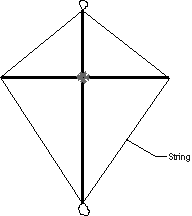
  1. Make a cross with the skewer sticks with the short stick across the longer stick like in the diagram below.
  2. Tie a string where the two sticks intersect to secure its shape and so it won't fall apart. You can put some glue so that it is easier to stay together.
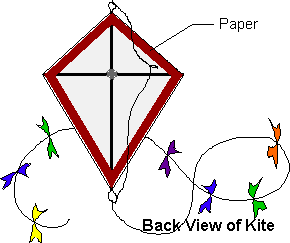
  3. Cut a little notch at the end of each stick so that a piece of string can fit through. After cutting, loop the string all around the cross so it makes the outline of a kite. See diagram below. The string has to be tight but not tight enough to bend the sticks.
  4. Place the material over the kite and leave a margin of around 2-3cm and warp it around. Stick the material down by using tape or glue.
  5. Loop another string down the back of the kite but leave a few metres extra hanging off the edge. This excess string is the "tail" of the kite where you hold on while it is in the sky.
  6. Repeat steps 1-5 for each kite but with different materials.
  7. Fly each kite and record each kite's height while flying.
  8. Repeat experiment to verify.
  9. Compare results and tabulate and/or create graphs showing similarities and connections between results.

WEBSITES/PRE-MADE METHODS OF MAKING KITES

I've been browsing some websites trying to find some ways to make a kite that will actually FLY. And I thought this method was pretty good.

DIAMOND KITE
Materials:
  • butcher cord or thin garden twine
  • scotch tape or glue
  • 1 sheet of strong paper (102cm x 102cm)
  • 2 strong, straight wooden sticks of bamboo or wooden doweling 90cm and 102cm
    • markers, paint or crayons to decorate you kite.

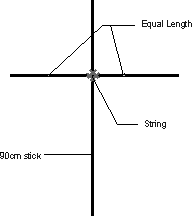
      1. Make a cross with the two sticks, with the shorter stick placed horizontally across the longer stick. Make sure that both sides of the cross piece is equal in width.

      2. Tie the two sticks together with the string in such a way as to make sure that they are at right angles to each other. A good way to ensure that the joint is strong to put a dab of glue to stick it in place.

      3. Cut a notch at each end of both sticks. Make it deep enough for the type of string you are using to fit in to. Cut a piece of string long enough to stretch all around the kite frame. Make a loop in the top notch and fasten it by wrapping the string around the stick. Stretch the string through the notch at one end of the cross-piece, and make another loop at the bottom. Stretch the string through the notch at one end of the loop at the bottom. Stretch the string through the notch at the other end of the cross-piece. Finish by wrapping the string a few times around the top of the stick and cutting off what you don't need. This string frame must be taut, but not so tight as to warp the sticks.

      4. Lay the sail material flat and place the stick frame face down on top. Cut around it, leaving about 2-3cm for a margin. Fold these edges over the string frame and tape or glue it down so that the material is tight.

      5. Cut a piece of string about 122 cm long. and tie one end to the loop at the other end of the string to the loop at the bottom. Tie another small loop in the string just above the intersection of the two cross pieces. This will be the kite's bridle, the string to which the flying line is attached.

      6. Make a tail by tying a small ribbon roughly every 10cm along the length of string. Attach the tail to the loop at the bottom of the kite.


      [Date accessed: 12/05/10] Last updated: 2010

      I don't have any bamboo sticks but I think I'll string some skewer sticks or try to find some long, thin, solid objects to replace it. Of course, instead of paper, I will replace the material of the kite with others.

      I've decided that I'm going to use the following as the other materials to test:
      Cotton, paper, cardboard, wool and calico or velvet. I will have to see whether I use calico or velvet because I have to find some first.

    Monday, April 19, 2010

    Climate graph


    My scanner isn't too good but here's my graph.


    Wednesday, March 10, 2010

    Decided :D

    I've decided to go with the kite one; "How does the material of a kite affect its flight?"
    I'm not sure if it would be too easy... need your "okay", Ms Zhang.

    Investigating whether the material of a kite will affect its flight.

    Method:
    1. Gather materials and equipment such as; wire, fabric, cardboard, scissors, etc.
    2. Use specific measurements so that all the kites are the same size and shape.
    3. Use wire to make the shape of the kite and use the ball of string as the rope.
    4. Fly each kite and record observations like how high each one flew, how fast each kite flew.
    5. Repeat steps 1-4 a few more times to verify answers.
    The independent variable would be the material of the kite and dependent variable would be the distance and height it flies as stated in previous post.

    More ideas?

    Some more ideas:
    • How does the material of a kite affect its flight?
      Independent variable - material of the kite
      Dependent variable - flight of the kite
    • How different soils affect a plant seed's growth
      Independent variable - different types of soil
      Dependent variable - seed
    I think I might do the first one but it might be a bit easy. I could make different kites of lots of different materials and test them out.

    Oh whattt

    Oh no D: I didn't know we had to be active on this blog... well here are some of my ideas for SRP that I've been considering:
    • Do all types of bread have the same mould?
      Independent variable - bread(?)
      Dependent variable - type of mould grown
    • Effectiveness of garlic in fighting bacteria
      Independent variable - garlic
      Dependent variable - growth/decline in bacteria
    • What effect do magnets have on the growth of seedlings?
      Independent variable - magnets
      Dependent variable - growth of seedlings
    I didn't want to do plants because everyone does it but it's really hard to find a good experiment and my brain capacity is just not big enough to think of a creative one. Would these be too easy?

    Thursday, February 4, 2010